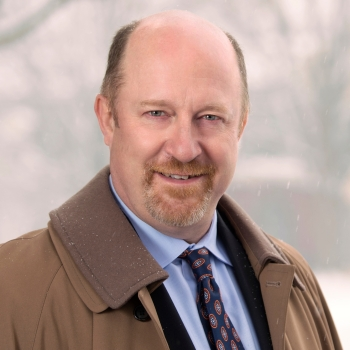
Karl Voss
Douglas K. Candland Dean of the College of Arts & Sciences
Your Impact
The activities of students and faculty supported by the Douglas K. Candland Fund for the College of Arts & Sciences are often the most meaningful educational opportunities that students have during their time at Bucknell. Many times these activities provide lessons and experiences carried with students after graduation and ones they talk about when they discuss being shaped by their Bucknell experience.
The Candland Fund supports activities for no longer than three years so the fund does not become the primary source of support for a limited amount of activities. My goal for the fund is for it to support the growth of timely and relevant ideas, lighting many different fires and energizing students and faculty across the College, maximizing the fund’s impact.
The Candland Fund for the College of Arts & Sciences has supported 105 undergraduate students in their travels off campus to disseminate their work with professional audiences at conferences and professional societies. Those 105 students were each assigned a faculty mentor, with 30 faculty members serving in those roles. Below is a summary of some of the work supported by this fund.
Professor Eric Faden brought two students to Japan to work on the Japanese Paper Film Project which involved handling, digitizing and processing rare 1930s Japanese paper films. The results of this project have been shared at a sold-out showing in New York City and Professor Faden is about to embark on a ten-city tour to share this work. As of the last few weeks, a new trove of early twentieth century paper films have been discovered in Japan and this exciting project will continue with the assistance of students.
Professor Ned Ladd led a team of students, faculty, and staff to Dallas, Texas for an eclipse expedition, collaborating with Greenhill School, an independent K-12 day school, to construct a field observation site and collect research data during the eclipse. This project mixed undergraduate research opportunities with public science and educational outreach that allowed our students to be part of a major astronomical event.
Professor Colin McKinney transformed his class, Exploring Spain: Food, Football and Fiction, into a sequence of high impact activities built around culinary exploration, having students cook Spanish-themed meals together and building connections to regions in Spain such as Andalucía, Catalonia, the Basque Country and Galicia.
Professors Roger Rothman and Erica Delsandro have been busy with a team of students creating an archive for a feminist magazine, Heresies, that was published by a feminist collective from 1977-1993. The magazine contains essays, short stories, poems, original visual art and other artifacts of the urban feminist movement of the time. Students are archiving, making it accessible and researching the history of the issues and the contributors. Many notable figures contributed to Heresies before becoming famous.
Professor Rebecca Slodovnik brought Dara Horn to campus and had her interact with students in her German Studies class entitled, “Never Again?”. Dara Horn is the author of the important work “People Love Dead Jews: Reports from a Haunted Present", which is a startling exploration of how Jewish history is exploited to flatter the living. Horn is a crucial contribution to campus discussions of Judaism, always an important topic and even more conspicuously so over the last year.
Professors David Del Testa and Adrian Mulligan focus on seeking ways to reduce the potential inequalities inherent in the study abroad experience. They are designing an app that allows individuals or groups to engage in self-guided, self-directed study abroad programs overseas, including course content, local information and assessments. Through this app individuals who cannot travel overseas can participate in video or audio simulacra of the self-guided programs, with accessibility being the main goal. In the long run they seek to connect with universities who may be interested in granting credit for those who participate in one of the programs. Their first efforts have focused on Japan using Matsuo Basho’s 1689 travel diary, “The Narrow Road to the Deep North” as the basis of the study abroad experience. The fund supported travel for faculty and students to Yamagata City in Yamagata Prefecture to gather sample video and audio along Basho’s route there and at places he mentions in his diary.
Professor Dale Stevens took four students to study the effects that distinct environments have had on black widow spider behavior. Desert and urban environments, both high- and low-income areas, have produced different behavioral responses to artificial light at night and elevated temperatures. This work is deeply tied to understanding the human impact on the environment and how other species are adapting, or not, to these impacts.
Professor Amy Wolaver and Professor John Doces seek to involve students in studying different dimensions of human behavior. Most social science research is based on the behavior of western, educated, industrialized, rich, democracies (WEIRD) populations. These research projects study how non- WEIRD populations, specifically in Cote d’Ivoire, engage in behavior different from the classical rational behavior models used by economists and political sciences. Students develop research projects, collect data to test the hypothesis and analyze the results.
Professor Anna Paparcone worked with students to organize a screening and symposium of women of African descent who work in the world of Italian cinema. The event was entitled, The Right to be (Seen). The participants included performers, directors and others in the cinema industry. They all came to Bucknell where they interacted with Bucknell students in film & media studies and Italian studies. The women from Italian cinematic careers were especially impressed with the sophistication, thoughtfulness and poise of our students. The event had a profound impact on all participants.
Professor Abby Flynt is leading a department-wide initiative in the Department of Mathematics to develop a calculus preparation program for students who are coming to Bucknell expecting to take calculus in their first year. Too often, calculus is a barrier rather than a bridge for students’ future studies at Bucknell. The department is deeply committed to creating an environment where mathematical instruction at Bucknell is a way of empowering students rather than sorting or filtering them. This initiative seeks to build a mathematical summer bridge opportunity for incoming students to put them in the best position to do well taking calculus. The need for such a program is more acute than ever and the number of students who will be impacted by this is in the hundreds each year.
Professor Mizuki Takahashi took two students to Japan for biological research. As part of the experience, he also provided instruction in Japanese language, culture and history. On the scientific front students worked on two ecological projects studying the Japanese Giant Salamanders (JGS). They conducted field surveys of hybrids between JGS and introduced Chinese Giant Salamanders and delineated the distribution range of JGSs using environmental DNA analysis.
Professor Jeff Trop from the Department of Geology took a student to study sedimentology and the provenance of Paleogene sedimentary strata in southern Alaska. This is a remote site and of great geological significance. This work built on a long foundation of research by Bucknell faculty at this Alaska location.
Your fund has enabled the College to a whole host of wide variety of new initiatives that we would not have been able to entertain in the past, thanks to the funding from this endowment. Going forward, the University is poised to move even more deeply in the direction of high impact practices and this fund will be a crucial pillar in leveraging that momentum.
